
AIIMS Cohort Study

All India Institute of Medical Sciences, New Delhi

Dementia


What is dementia?

The word dementia describes a set of symptoms that may include memory loss and difficulties with thinking, problem-solving or language. Dementia is progressiveneuro-degenerative disorder, which means the symptoms gradually getworse over time. How quickly dementia progresses vary greatly fromperson to person.A person with dementia may also experience changes intheir mood or behaviour andthere is a reduction in activities of daily living such as washing, dressing, cooking and caring for self.

Memory loss - this can be one of the first symptoms that people notice. The observations people report include - noticing their loved ones forgetting things that have happened earlier in the day, getting confused about messages and who people are, repeating themselves, and appearing not to be paying attention or following conversations.

Problems with communication - Some people experience problems with expressing themselves, talking and understanding things. They get confused about words and might use the wrong words for common things and mix words up.

There are a number of different types of dementia the most common being Alzheimer's disease, Vascular dementia, Fronto temporal dementia and Dementia with Lewy bodies.

What causes of dementia?

  • Aging is the single biggest risk factor for the development of dementia, while there are clearly some cases of dementia that are caused by positive family history.
  • A number of dietary and lifestyle choices can modulate the development and progression of dementia and brain pathology. Obesity and diabetes may be potent modulators of dementia.
  • Can occur as a complications of chronic high blood pressure, blood vessel disease or a previous stroke
  • Can occur with other neurodegenerative disorders like Huntington’s disease, Parkinson’s disease, etc.

What are the symptoms of Dementia?

Each person is unique and will experience dementia in their own way. A person with dementia will have cognitive symptoms (problemswith thinking or memory). They will often have problems with some ofthe following:
  • Day-to-day memory – difficulty recalling events that happenedrecently, this is progressive in nature.
  • Concentrating, planning or organising – difficulties makingdecisions, solving problems or carrying out a sequence of tasks (egcooking a meal)
  • Language – difficulties following a conversation or finding the rightword for something
  • Visuospatial skills – problems judging distances (eg on stairs) and seeing objects in three dimensions
  • Orientation – losing track of the day or date, or becoming confusedabout where they are.
  • Changes in Mood- For example, they may become frustratedor irritable, withdrawn, anxious, easily upset or unusually sad.
  • With some types of dementia, the person may see things that arenot really there (visualhallucinations) or believe things that are nottrue (delusions)
  • In later stage- physical symptoms such as muscle weakness or weight loss is common. Changesin sleep pattern and appetite are also common.

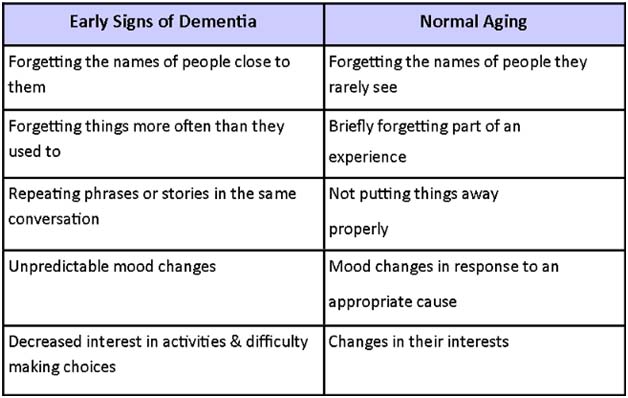
What is the difference between dementia and normal ageing?

How is dementia diagnosed?

There is no single test for dementia. A diagnosis is based on a combination of assessments:

Taking a history – Detailed history with assessment of a person's behaviours or abilities might be made.

Physical examinations and tests – A full physical examination should take place as part of the assessment. This may include an assessment of heart and lung functioning and blood pressure, full blood count, vitamin B12 and foliate testing, glucose testing, thyroid testing and a urine assessment to exclude other possible causes of the symptoms.

Note:The following conditions can cause similar symptoms to those of dementia but may be reversible and should always be explored.

  • Chest and urinary infections; Infected pressure sores; Severe constipation; Depression; Side effects from medication; Taking medications incorrectly or taking medication that has not been prescribed; Vitamin and thyroid deficiencies; Brain tumours and normal pressure hydrocephalus; Sudden changes such as moving house or bereavement; Poor sight or hearing; Alcohol (even in small amounts)


Tests of cognitive (mental) abilities – A more detailed assessment of memory and other thinking processes should be done. This assessment consists of a range of pen-and-paper tests and questions. These will test things like memory, orientation, language and visuospatial skills (eg copying shapes). These tests can be very good at helping to determine the type of problem a person may have, particularly in the early stages.

Brain Scans – There are several types of brain scan:

  • CT (computerised tomography), CAT (computerised axial tomography) and MRI (magnetic resonance imaging) scans are widely used. They all show structural changes to brain tissue.
  • SPECT (single photon emission computerised tomography) and PET (positron emission tomography) scans are less widely used. They show changes in brain activity.

How is dementia treated?

The vast majority of causes of dementia cannot be cured, although research is continuing into developing drugs, vaccines and other medical treatments. There is also a lot that can be done to enable someone with dementia to live well with the condition. Care and support should be ‘person-centred’.

Medical Treatment There are drugs that can help to improve the symptoms of dementia or that, in some cases, may stop them progressing for a while.

  • A person with mild to moderate Alzheimer’s disease or mixed dementia may be prescribed donepezil (often known by the brand name Aricept), rivastigmine (eg Exelon) or galantamine (egReminyl). These may temporarily relieve memory problems and improve alertness, level of interest and daily living.
  • In the moderate or severe stages of Alzheimer’s disease someone may be offered memantine (egEbixa). This may help with mental abilities and daily living, and ease distressing or challenging behaviours and delusions


Non-drug treatments and support

A range of support groups, therapies and activities can help someone to live well with dementia.

  • Talking therapies, such as counselling, can help someone come to terms with their diagnosis. Another treatment called cognitive behavioural therapy (CBT) may be offered to help with depression or anxiety
  • Cognitive rehabilitation can enable an individual to retain mental skills and raise their confidence.
  • Activities that help to keep the mind active, such as cognitive stimulation, are regularly used. Such activities may help improve someone’s mental abilities, mood and wellbeing.